A couple of days ago, I received a message on Grindr, the gay community’s more casual version of Tinder (read: it’s used exclusively for sex 90% of the time). The message read, “want to parTy tonight?” The lone capital T was not a typo. A capital “T” is code for “tina,” a street name for meth popularized by the gay community (according to this theory, “crystal meth” became “crystal”, “crystal” transformed into “Christina”, and “Christina” was shortened to “Tina”). Hence, the message I received translates to, “Would you like to come over, shoot up, and have unprotected sex with me?” This is the third time I have received a message like this since being back on campus. The gay community has a serious substance abuse problem that needs to be dealt with.
According to Girshick (2002), there are two distinct factors that could possibly explain the queer community’s higher rates of serious drinking problems and drug abuse: “that much of our socialization occurs in bars” and that “queer community members use substances to cope with the impact of isolation, alienation, and oppression from societal homophobia.” While I do believe Girshick’s (2002) theories have merit, I do not think they are complete. While I do not claim to be an expert on queer history or culture, I believe there is a more simple and holisitc explanation for these high rates of abuse: recreational drug use has become synonymous with gay culture.
I should clarify – recreational drug use has become synonymous with gay male culture, especially in the context of gay sex. I cannot talk about lesbian, bisexual, trans, or queer communities in a broad sense because I simply do not know about their cultures nor sexual mores like I do within my own community (even when I tried to find research that examined the differences in substance abuse in the gay community vs. the lesbian community, for example, the best I could find was this, a report from the Substance Abuse and Mental Health Services Administration which concludes that “sexual minorities” are more at risk for substance abuse issues). This calls attention to another matter altogether: studies of sexual violence – and health in general – need to be “queered” (Patterson, 2014; 2016).
Hence, I can only speak from personal experience, and from personal experience, I can corroborate the conclusion reached by Kimmel (2005) in his piece on masculinity: male sexuality is predicated upon “risk-taking,” “excitement,” and “danger.” Shooting up meth before engaging in unprotected sex definitely checks all of these boxes. Further, since the AIDS crisis of the 80s (fuck you, Ronald Reagan), each and every sexual interaction between two men is clouded by fear and anxiety – drugs eliminate these fears. This is not new. Poppers, ecstasy, cocaine, GHB, and heroin have all had their fifteen minutes of fame in the gay community, but it seems as if meth is our new drug du jour. All of these drugs reduce inhibitions and increase pleasure, two things that make it easier for men to continuously justify engaging in high-risk sexual behavior.
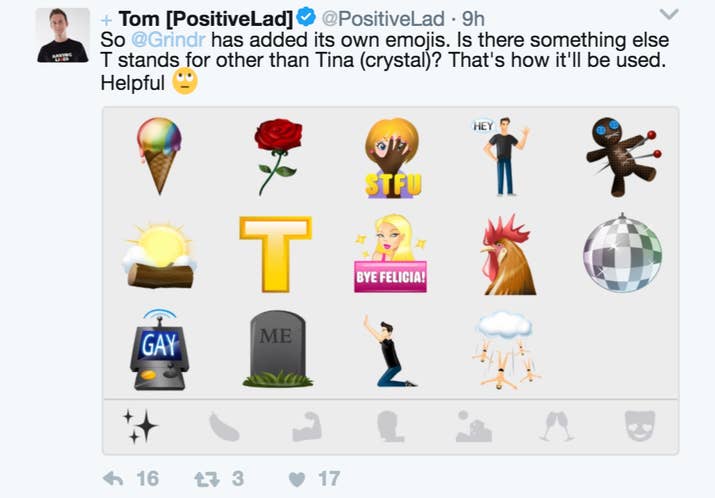 |
| While Grindr has since removed the "T" emoji after an enormous amount of backlash from the gay community, it is troubling that it even existed in the first place. |
To further drive this point home, Kimmel (2005) reveals that AIDS is “perhaps the most gendered disease in American history” and that in the United States, “more than 85 percent of people with AIDS are men.” This is not surprising when one remembers that the most common way to use meth is via injection, and sharing needles is the most common way to contract HIV. Gay sex is inextricably linked to drug use and drug use is inextricably linked to HIV. If this is so obvious, why is it so hard to fix? Why do gay men continue to abuse drugs and engage in risky behavior? At the end of the day, gay men are still men, and are therefore gripped by the crushing fear of what will happen to them if they don’t conform to masculine ideals. In short, “to men, safer sex is an oxymoron...that which is sexy is not safe; that which is safe is not sexy” (Kimmel, 2005, emphasis in original).
While the gay community is disproportionately affected by substance abuse problems, the heterosexual community is not completely immune: the “silent killer,” meth, is back with a vengeance. Meth is not simply a “gay issue.” Even closer to home, the Erie Drug Task Force indicates that northwestern Pennsylvania has become a sort of meth mecca, which means that I definitely am not the only young gay man on this campus who has been invited to “parTy.” I hope that I am not alone in rejecting this invitation. Men, and not just gay men, need to be having safer sex. Even though masculinity deems the opposite, there is nothing sexier than safety. Altering masculinity and male sexuality is the responsibility of every single male identifying person. Do your part. Please be safe.
Works Cited:
Girshick, L. B. (2002). Woman-to-Woman Sexual Violence: Does She Call It Rape? Boston, MA: Northeastern University Press.
Kimmel, M. (2005). Men, Masculinity, and the Rape Culture. In E. Buchwald, P. R. Fletcher, & M. Roth (Eds.) Transforming Rape Culture (140-157). Minneapolis, MN: Milkweed Editions.
Patterson, J. (2014, April 10). Queering Sexual Violence: Radical Voices from Within the Anti-Sexual Violence. The Feminist Wire. Retrieved from: http://thefeministwire.com/2014/04/queering-sexual-violence/
Patterson, J. (2016). Queering Sexual Violence: Radical Voices from Within the Anti-Violence Movement. Riverdale, NY: Magnus Imprint Books.
Comments
Post a Comment